Your best-performing ad channel is showing cracks. CPCs are climbing. Frequency caps are tightening. Conversion rates are dipping quarter over quarter. This is platform fatigue, and it hits every advertiser who depends too heavily on a single channel.
Diversifying your paid media mix is not a nice-to-have. It is survival. Here is how to do it before the numbers force your hand.
How Platform Fatigue Actually Works
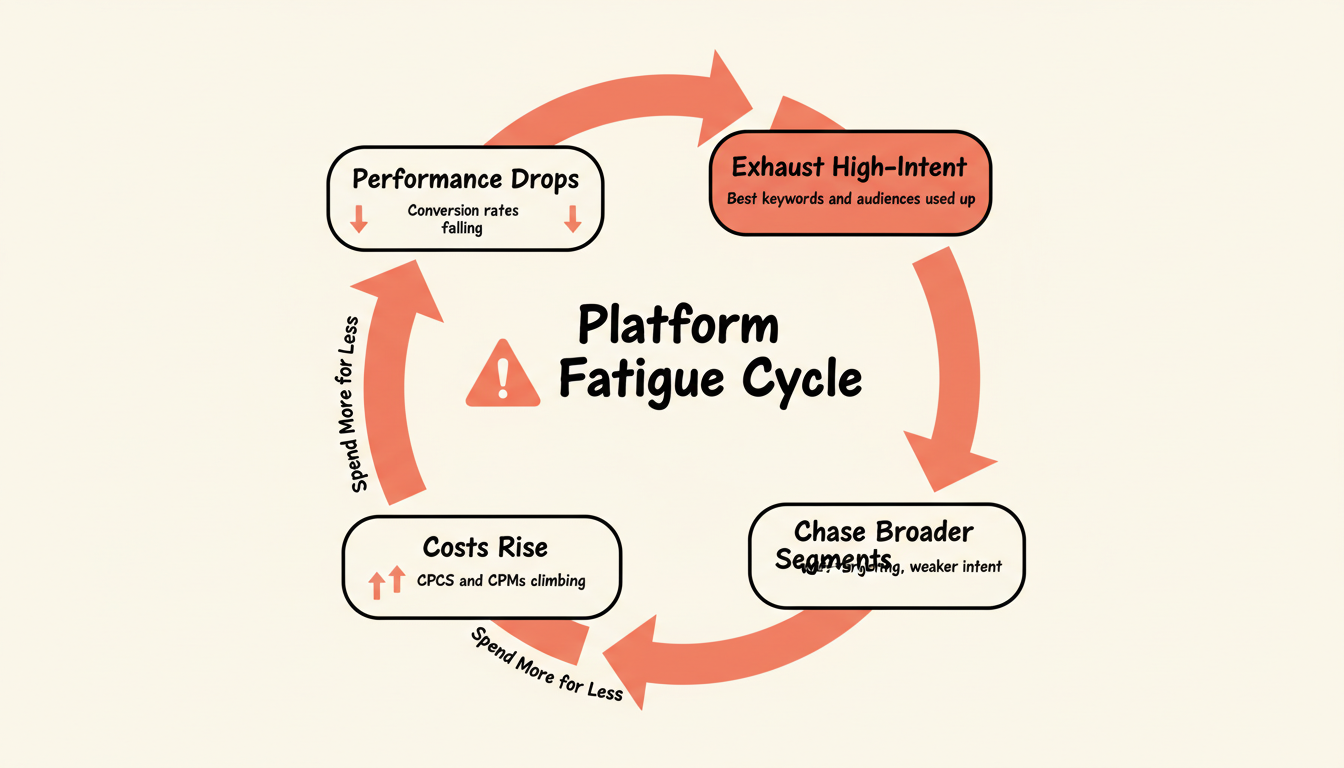
Every ad platform has a ceiling for any given advertiser. You exhaust the high-intent keywords first. Then the warm audiences. Then you start chasing broader segments with weaker intent, paying more for less.
Meta’s algorithm compounds the problem. As your audience sees the same ads repeatedly, engagement drops. The algorithm responds by charging you more to maintain the same delivery. You are caught in a cycle: worse performance leads to higher costs leads to worse performance.
Google has its own version. Competitive keyword categories see bid inflation of 10-20% annually. Your budget buys less traffic every year even if your campaigns stay perfectly optimized.
Platform fatigue is not a signal to optimize harder. It is a signal to go somewhere new.
What Smart Diversification Looks Like
Adding Reach That Does Not Overlap
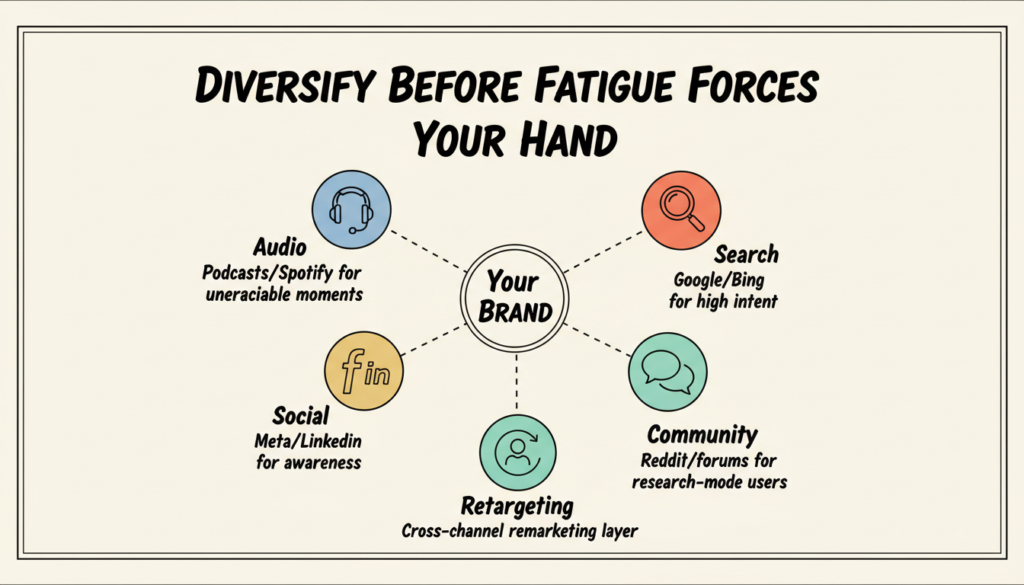
The goal is not to run the same ads on more platforms. It is to find audiences your current channels cannot reach. Community platforms, niche networks, and interest-based platforms attract users who do not engage with traditional ad networks. When you advertise on reddit, you access communities of technical buyers and early adopters who actively avoid Meta and Google ad ecosystems.
Testing Channels With Different User Behavior
Each platform attracts a different mindset. Search users have active intent. Social users are passive. Community users are in research mode. A diversified mix covers all three mindsets, catching buyers at different stages of their decision process.
Preserving Budget for Your Proven Channel
Diversification does not mean abandoning what works. Keep 50-60% of budget on your strongest channel. Allocate 25-30% to a secondary channel showing early promise. Reserve 10-20% for pure experimentation on new platforms.
Building a Creative Pipeline That Serves Multiple Formats
Different platforms need different creative. Reddit wants conversational text. Meta wants video. Google wants tight headline copy. Building a creative pipeline that produces format-specific assets keeps your team from recycling the same ad everywhere.
Measuring Incrementality, Not Just Performance
A new channel might look expensive on a last-click basis while actually driving incremental pipeline your other channels would never have captured. Run incrementality tests — geographic holdouts or randomized exposure studies — to measure real contribution beyond what attribution models show.
Setting Channel-Specific Benchmarks
A $15 CPC on LinkedIn is normal. A $15 CPC on Reddit means something is wrong. Each platform has its own cost structure. Set benchmarks based on platform norms, not your blended average.
A Practical Diversification Playbook
Audit your current channel dependency. If more than 70% of your paid pipeline comes from one platform, you are exposed. Document exactly how much revenue depends on each channel.
Identify two candidate channels based on audience match. Where does your ICP spend time outside of Google and Meta? Trade publications, community forums, podcasts, and niche social platforms are all options. Pick two with strong audience overlap to your buyers.
Run a 30-day test with meaningful budget. “Meaningful” means enough to generate at least 100 clicks and a handful of conversions. Anything less is noise. When you advertise on reddit or test any new platform, commit enough budget to exit the learning phase.
Compare 60-day pipeline contribution, not 7-day ROAS. New channels often have longer conversion cycles because they catch buyers earlier in the journey. Give them a fair measurement window.
Rotate experimental budget quarterly. If a test channel does not show signal in 60 days, cut it and test the next one. If it shows promise, graduate it to your secondary channel slot and open the experimental slot for something new.
What Happens If You Wait
Platform fatigue does not reverse itself. CPCs do not drop because you wish them lower. Audience saturation does not fix itself because you refresh your creative.
Companies that diversify their paid media mix before fatigue hits maintain lower blended CAC as they scale. Companies that wait until performance collapses scramble to find alternatives under pressure, with less budget and less time to learn.
The best time to test a new channel is when your current one is still working. You have the budget, the data, and the breathing room to experiment. That window closes faster than most teams expect.