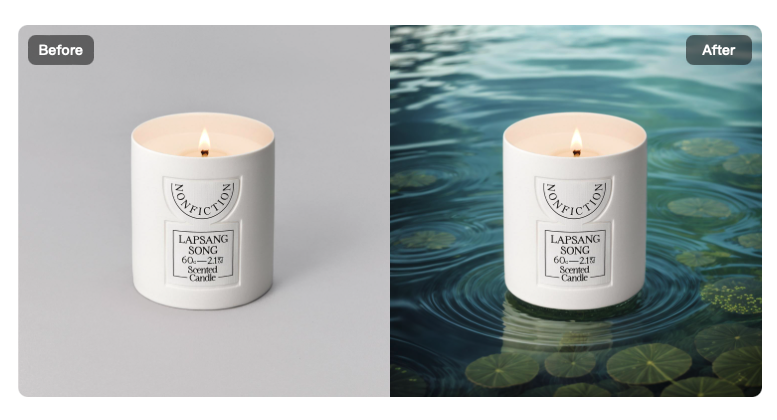
Online sellers no longer need a camera, studio, or professional photographer to get scroll-stopping product images. Thanks to advances in artificial intelligence, an AI product photo generator can now turn a simple smartphone photo into a polished, marketing-ready image in minutes. Combined with the broader shift toward AI product photography as a category, this technology is quickly becoming the standard way e-commerce brands create visual content.
What Is an AI Product Photo Generator?
An AI product photo generator is a software tool that uses machine learning to transform a raw, unedited product photo into a professional-looking image. Instead of hiring a photographer, sellers simply upload a picture — often taken with nothing more than a phone — and the AI adds realistic lighting, backgrounds, shadows, and composition automatically.
These tools are built on deep-learning models trained on millions of professional photographs. The AI has learned how light falls on different materials, how shadows behave naturally, and how backgrounds should be composed, so the final image looks authentic rather than artificially edited.
One of the biggest advantages is accessibility. Most platforms are designed specifically for non-designers, so no photography or editing experience is required. Users upload their photo, choose a background or style, and the software handles the rest. This works across almost every product category — clothing, electronics, jewelry, cosmetics, and furniture all benefit from category-specific presets that adjust lighting and staging appropriately.
Speed is another major factor. A traditional photoshoot can take days to schedule, set up, and edit, while an AI photo generator can produce multiple finished variations of the same product in just a few minutes.
Understanding AI Product Photography as a Whole
AI product photography refers to the broader practice of using AI tools consistently across an entire catalog — not just generating a single image, but building a complete visual strategy that spans product listings, marketing creatives, and seasonal campaigns.
Rising marketing costs, the need for constant content refreshes, and demand for fast A/B testing have pushed more brands toward AI-driven photography in 2026. It’s simply more efficient than repeating traditional shoots every time a new product or campaign launches.
Clean, professional, and contextually relevant product images are strongly linked to higher buyer trust and better conversion rates. When customers can clearly see what they’re buying, they’re more likely to complete a purchase and less likely to request a return. Most AI-generated images now meet the resolution and quality standards required by major marketplaces, including clean backgrounds and consistent lighting suitable for Amazon, Shopify, and other platforms.
Consistency at scale is one of AI photography’s biggest strengths. Sellers can save a specific style or background preset and apply it uniformly across an entire catalog — something that’s difficult and expensive to replicate with traditional photography, especially for stores with hundreds of SKUs.
How to Get Started
The process begins with a clear, well-lit photo of the product, ideally against a plain background. The quality of the source image directly affects the quality of the AI’s final output. From there, the photo is uploaded to a platform like ProductProAI, where the seller selects a preferred background, lighting style, or scene, and the AI generates a finished image within moments.
Most tools allow multiple style variations to be generated from a single source photo, making it easy to run A/B tests across a store or ad campaign to see which visuals perform best. For final use, images should be exported in high-resolution JPEG or PNG format and resized according to platform requirements — square formats for Instagram, specific dimensions for Amazon, and so on.
Pricing is typically credit or subscription-based, which makes processing a full catalog in bulk far more cost-effective per image than paying for individual photoshoots.
Comparing AI Photography to Traditional Photography
Traditional photography still offers advantages such as full creative control, the ability to physically style products and props, and complete art direction during the shoot itself. However, AI-generated photography wins clearly on speed and cost — dozens of professional image variations can be produced in the time it would take to set up a single traditional photoshoot.
For sellers who need frequent new content, large catalogs, or seasonal refreshes, AI photography is significantly cheaper in the long run. Traditional photography still holds value for flagship brand campaigns, storytelling-driven content involving real models, or highly unique creative concepts — areas where AI hasn’t fully caught up yet.
Common Questions and Concerns
A frequent concern among sellers is whether AI-generated images will look fake to customers. In practice, when done well, most shoppers can’t distinguish AI-generated images from professionally shot ones, since quality platforms prioritize photorealism specifically to avoid an artificial appearance.
Ownership is another common consideration. With most platforms, sellers retain full usage rights to images created from their own product photos, though it’s always worth confirming the specific licensing terms of whichever tool is chosen.
The most common mistake sellers make is using a poor-quality source image. Blurry, poorly lit, or awkwardly angled photos limit what the AI can produce, regardless of how advanced the software is. Fortunately, many platforms, including ProductProAI, offer a free trial or limited free credits, allowing sellers to test output quality before committing to a paid plan.
Final Thoughts
Whether the goal is a one-time solution with an AI product photo generator or a long-term AI product photography workflow for an entire catalog, the technology has matured to the point where it’s a genuinely practical alternative to traditional photoshoots. For most online sellers — especially those without large marketing budgets — it offers the best combination of speed, cost, and professional quality currently available.