Modern machine shops are under constant pressure to do more with less. Customers want shorter lead times, higher accuracy, and greater flexibility, while manufacturers must control labor costs, reduce setup waste, and keep machines producing as much as possible. These challenges become even more demanding in short-run and high-mix environments, where operators may switch from one part to another several times a day. In this type of production, the vise is not just a tool for holding material. It becomes a critical factor in setup speed, repeatability, and workflow stability.
That is one reason self-centering workholding has become more attractive in recent years. Many shops have realized that when production includes frequent changeovers and smaller batch sizes, traditional clamping methods can create too much variation and consume too much setup time. A more repeatable and efficient solution is often needed to keep operations competitive.
Why High-Mix Production Creates Workholding Challenges
In long production runs, setup time is spread across many parts, so a slower setup can sometimes be tolerated. In short-run work, however, setup efficiency matters much more. If a machinist spends a large amount of time aligning, adjusting, and checking each new setup, the machine may spend too much of the day idle. This reduces productivity and makes it harder to maintain consistent output.
High-mix production adds another layer of difficulty. Different jobs may require different part sizes, different jaw contact points, and different machining access. If the workholding system is not flexible enough, each new part becomes a setup problem that must be solved from the beginning. That slows down production and increases the risk of inconsistency between operators or shifts.
This is why workholding in high-mix shops must support both flexibility and repeatability at the same time. A vise should help operators move quickly without sacrificing control over part position.
The Value of Self-Centering Design
A self-centering design offers a clear advantage in this type of environment because it simplifies one of the most important parts of the setup process: locating the workpiece consistently. Instead of depending entirely on manual adjustment to align the part, the vise helps position it in a more balanced and repeatable way.
This kind of positioning consistency is valuable in any machining process, but it becomes especially useful when setups change frequently. Operators can load parts with greater confidence, reduce adjustment time, and maintain a more standardized routine from one job to the next. Even when the batch size is small, the time saved on each setup can add up quickly over the course of a week.
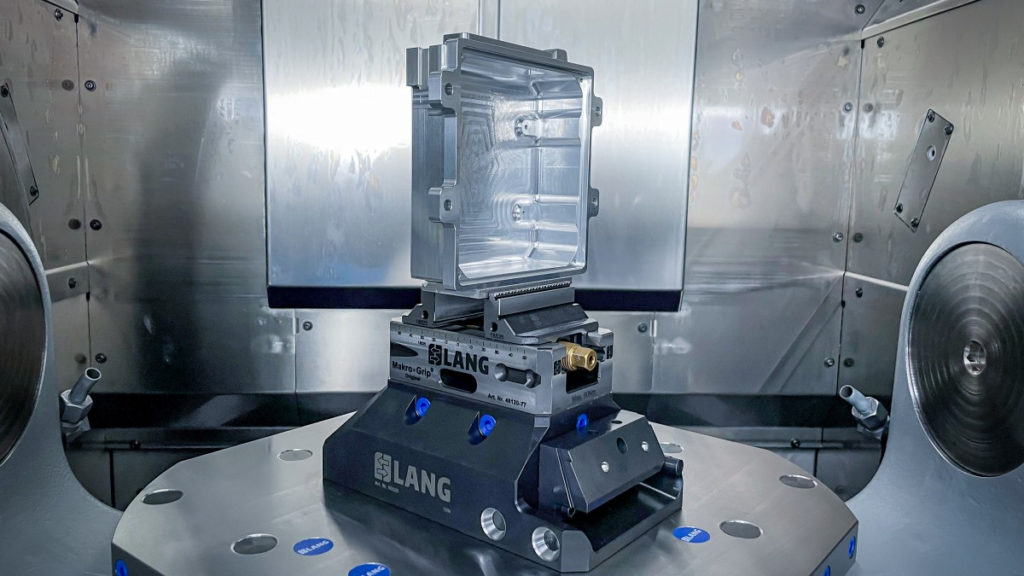
For shops handling advanced multi-side machining, a dedicated 5 axis vise can provide an additional benefit by improving access to more part surfaces while still supporting repeatable clamping.
Faster Changeovers Improve Shop Efficiency
One of the biggest productivity goals in high-mix manufacturing is reducing downtime between jobs. The faster a machine can move from one setup to another, the more time it spends making parts instead of waiting for preparation. This is where the right workholding choice can have a major effect on overall efficiency.
A self-centering vise helps reduce the number of small alignment tasks that normally slow down a changeover. Instead of spending extra time fine-tuning the workpiece position for every new part, the operator can rely on a more controlled and predictable clamping action. This not only saves time, but also makes it easier to train operators and standardize procedures across the shop.
In many cases, companies trying to improve setup efficiency begin by reviewing their broader cnc vise options rather than continuing to use the same general-purpose setup for every job. A wider product range gives them a better chance of matching the workholding style to the actual production environment.
Repeatability Matters Even More in Small Batches
Some manufacturers assume that repeatability is mainly a concern in high-volume production. In reality, it is just as important in small-batch work. When the lot size is limited, there is less room to absorb mistakes. A setup issue on one or two parts can represent a much larger percentage of the total order, making scrap or rework more expensive.
Repeatable workholding helps reduce that risk by giving each part a more consistent starting position. When the setup remains stable, operators can spend less time checking offsets and making corrections. This improves confidence, which is especially important in shops that handle a wide variety of parts and cannot rely on the exact same routine every day.
A properly selected cnc vise supports this kind of process stability. It allows the shop to maintain better control over part location even when jobs change frequently and setup windows are short.
Better Access Helps Short-Run Shops Do More in One Setup
Short-run shops often benefit greatly from reducing setup count. Since each setup consumes a relatively large share of total job time, completing more machining in a single clamping cycle can dramatically improve efficiency. This makes tool access a very important part of workholding selection.
Traditional vises may offer acceptable holding force, but they can also block critical surfaces and force additional repositioning. That increases setup complexity and introduces more opportunity for misalignment. For shops machining complex geometries, this can become a significant bottleneck.
A specialized 5 axis vise helps address this by exposing more of the workpiece and reducing interference. In practical terms, this means more features can be machined without removing and re-clamping the part. For short-run work, fewer setups often translate directly into lower labor time and better overall consistency.
Flexibility Is a Long-Term Advantage
Another reason self-centering vises are a smart choice for high-mix production is that they support long-term flexibility. Customer demand changes quickly, and many shops are expected to take on a wide range of work without warning. Under those conditions, rigid setup methods can limit growth and make new jobs harder to process efficiently.
By choosing a more adaptable workholding solution, manufacturers can create a setup strategy that works across a wider variety of parts. This does not mean one vise will solve every problem, but it does mean the shop can operate with more consistency and less wasted effort when production demands change.
That is why evaluating a full cnc vise lineup is often a practical step for buyers. A broader selection makes it easier to choose solutions that support both current work and future requirements.
Conclusion
Short-run and high-mix machining demand a different kind of efficiency. In these environments, setup time, repeatability, and flexibility are often just as important as cutting speed. Self-centering vises help meet those demands by improving part location, shortening changeovers, and supporting a more predictable workflow.
For shops trying to stay competitive in flexible manufacturing, better workholding is not a luxury. It is a practical way to reduce wasted time and improve consistency across changing jobs. In the end, the right vise does more than hold the part. It helps the entire shop move faster and work smarter.